Sony Sonnar T* FE 35mm F2.8 ZA vs Viltrox AF 40mm F2.5 Air
Every published spec side by side, with today's lowest prices for the market you've chosen.
Key differences
- Maximum aperture: f/2.5 on the AF 40mm F2.5 Air, against f/2.8 on the Sonnar T* FE 35mm F2.8 ZA.
- Closest focus: 0.34 m on the AF 40mm F2.5 Air, against 0.35 m on the Sonnar T* FE 35mm F2.8 ZA.
- Max magnification: 0.14× on the AF 40mm F2.5 Air, against 0.12× on the Sonnar T* FE 35mm F2.8 ZA.
- Weather sealed: Yes on the Sonnar T* FE 35mm F2.8 ZA, against No on the AF 40mm F2.5 Air.
- Weight: 120 g on the Sonnar T* FE 35mm F2.8 ZA, against 180 g on the AF 40mm F2.5 Air.
Sonnar T* FE 35mm F2.8 ZA or AF 40mm F2.5 Air: which should you buy?
Choose the Sonnar T* FE 35mm F2.8 ZA for its weather sealed and weight.
Choose the AF 40mm F2.5 Air for its maximum aperture, closest focus and max magnification.
On paper the AF 40mm F2.5 Air wins more rows (3 to 2); if the Sonnar T* FE 35mm F2.8 ZA's strengths are the ones you shoot with, and its price is lower where you buy, it can still be the better buy.
 | 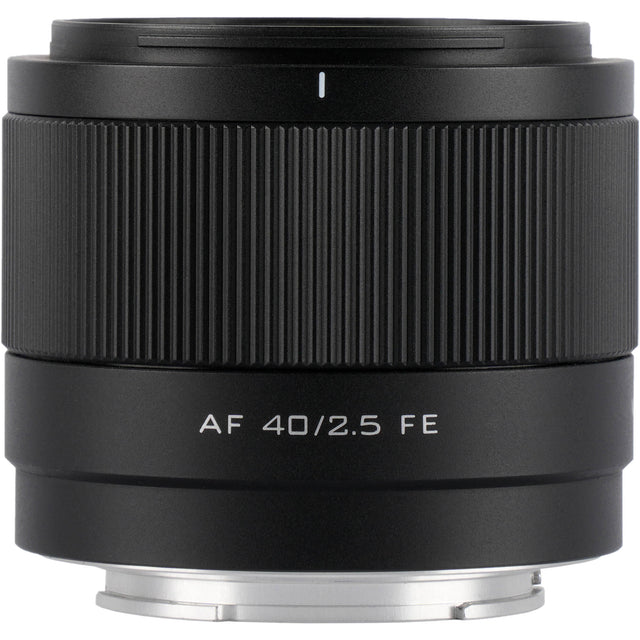 | |
|---|---|---|
| Lowest price today | $648 new $251 used | $168 new |
| Optics | ||
| Focal length | 35mm | 40mm |
| 35mm equivalent | 35mm (full frame) | 40mm (full frame) |
| Maximum apertureLower f-number lets in more light. A zoom wins only when it is as bright at both ends. | f/2.8 | f/2.5 (best) |
| Minimum aperture | f/22 | f/16 |
| Made for | Full frame | Full frame |
| Elements / groups | 7 / 5 | 10 / 6 |
| Aperture blades | 7 | 7 |
| Closest focus | 0.35 m | 0.34 m (best) |
| Max magnification | 0.12× | 0.14× (best) |
| Focus & handling | ||
| Autofocus | Yes (Linear) | Yes (STM) |
| Optical stabilisation | No | No |
| Weather sealed | Yes (best) | No |
| Internal zoom | — | — |
| Aperture ring | No | No |
| Teleconverter compatible | No | No |
| Size & weight | ||
| Weight | 120 g (best) | 180 g |
| Diameter × length | 61.5 × 36.5 mm | 68 × 55.9 mm |
| Filter thread | 49 mm | 52 mm |
Green marks the better figure where “better” is unambiguous. A dash means the maker doesn't publish it or we haven't verified it yet.